OSHA VPP · Gap assessment · Application
VPP isn't easy.It doesn't have to be complicated.
The PraxysEHS VPP Gap Tool helps you get your site ready for OSHA's Voluntary Protection Programs: score all 61 requirements against OSHA's own words, give every gap an owner and a date, keep the evidence in one place, and write the application as you go.
From gap to Star, one sub-element at a time.
14 days free on your first site. No card needed. Free for consultants.
Lakeview Plastics · Dayton plant
Getting ready for Star
in place?38%38%52%64%81%96%
- 1Score
- 2Gaps
- 3Proof
- 4Guidance
- 5Dates
- 6Apply
Before
Your VPP plan lives in three places.
61 rows. 14 tabs.
Column K says “Y?”
The blue binder
Left with the last safety manager.
VPP_App_FINAL_v7.docx
Three people say theirs is newest.
So where does the site really stand?
Score
All 61 requirements, against OSHA's own words.
E3.H · TREND ANALYSIS
OSHA's words, quoted
Chapter, section and page
Not in place
Gaps
Every gap gets an owner and a date.
Review injury trends every quarter
Owner Dana RuizDue Dec 4
Emails 3 days before, on the day, and weekly if late
Proof
The evidence sits with the requirement.
E3.H Trend analysis
Not in placeIn place since March
Gap closed, with the proof linked.
Guidance
Advice from people who've done it.
Paper
Document review
People
Interviews
Places
Observation
How OSHA's on-site team checks a site. Labeled as ours, kept apart from OSHA's words.
Dates
OSHA's dates and yours, in one place.
NOV
20
VPP committee meets
Your committee
DEC
4
Trend review due
Dana Ruiz
FEB
15
Annual self-evaluation
From OSHA's manual
OSHA's dates are worked out for your site, each with where it comes from.
Apply
The application, written as you go.
Answers written61 of 61
E1.A Statement of commitmentFinalVersion 7. Actually the newest.
7 of 7 attachmentsGap report · PDF · Word
Ready to apply. One sub-element at a time.
A made-up site, as the app shows it.
How it usually goes
You already have a VPP plan.It lives in three places.
The spreadsheet
61 rows. 14 tabs. One macro nobody touches.
Column K says "Y?" Nobody remembers who typed it, or what the question mark was worried about.
The evidence binder
"It's in the binder."
The blue one. It left with the last safety manager, along with the only signed copy of the policy.
The application
VPP_App_FINAL_v7_use-this-one.docx
Three people edited it last week. Each is sure theirs is the newest. All three are partly right.
How it works
One place for the whole job.In the order you do it.
- 01
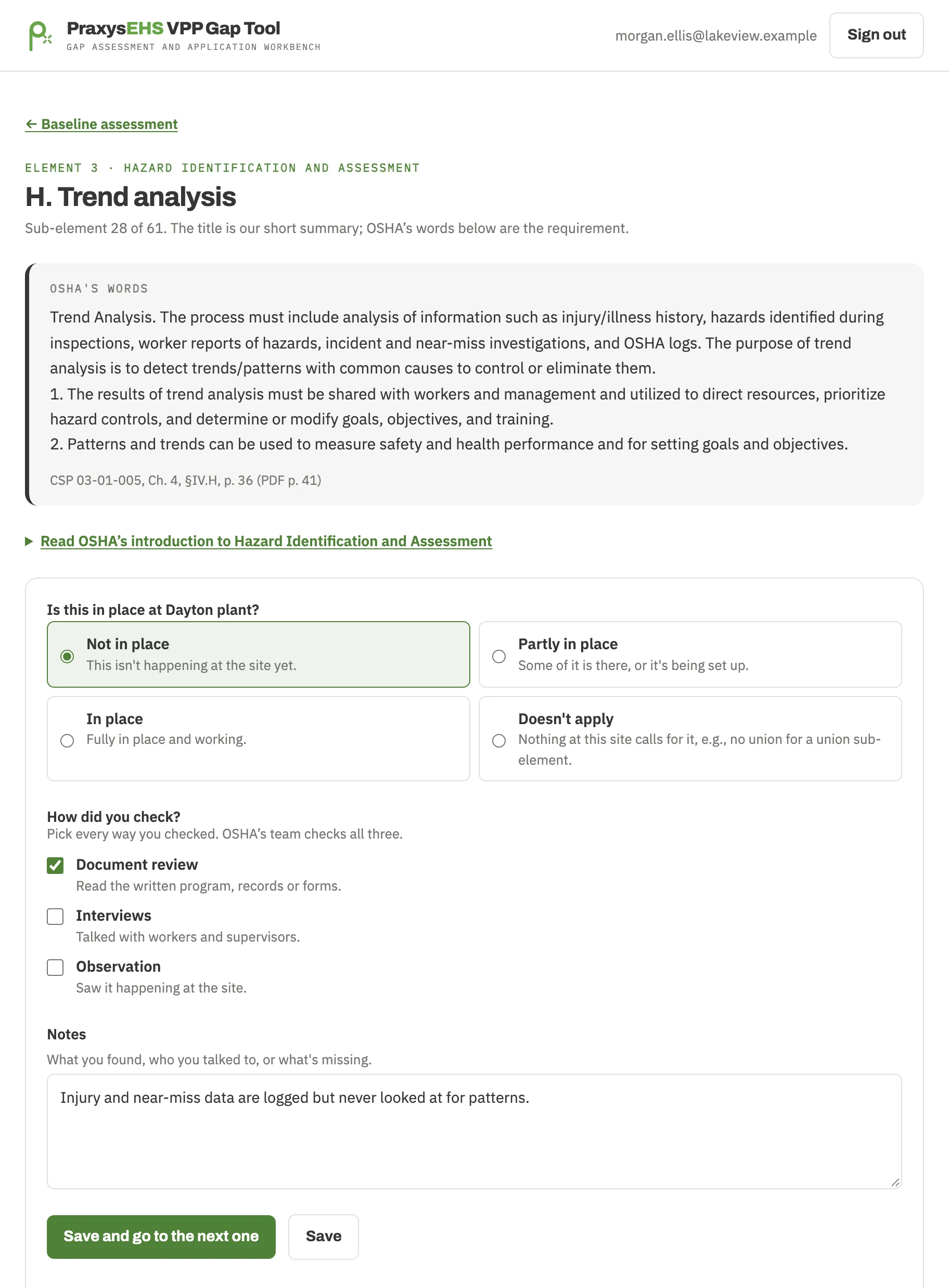
Score every requirement against OSHA's own words
All 61 sub-elements of OSHA's VPP manual, one at a time. Each shows OSHA's text and the page it's on, then asks a plain question: is this in place at your site? Note how you checked (documents, interviews, seeing it happen) and since when, because Star needs a year.
- 02
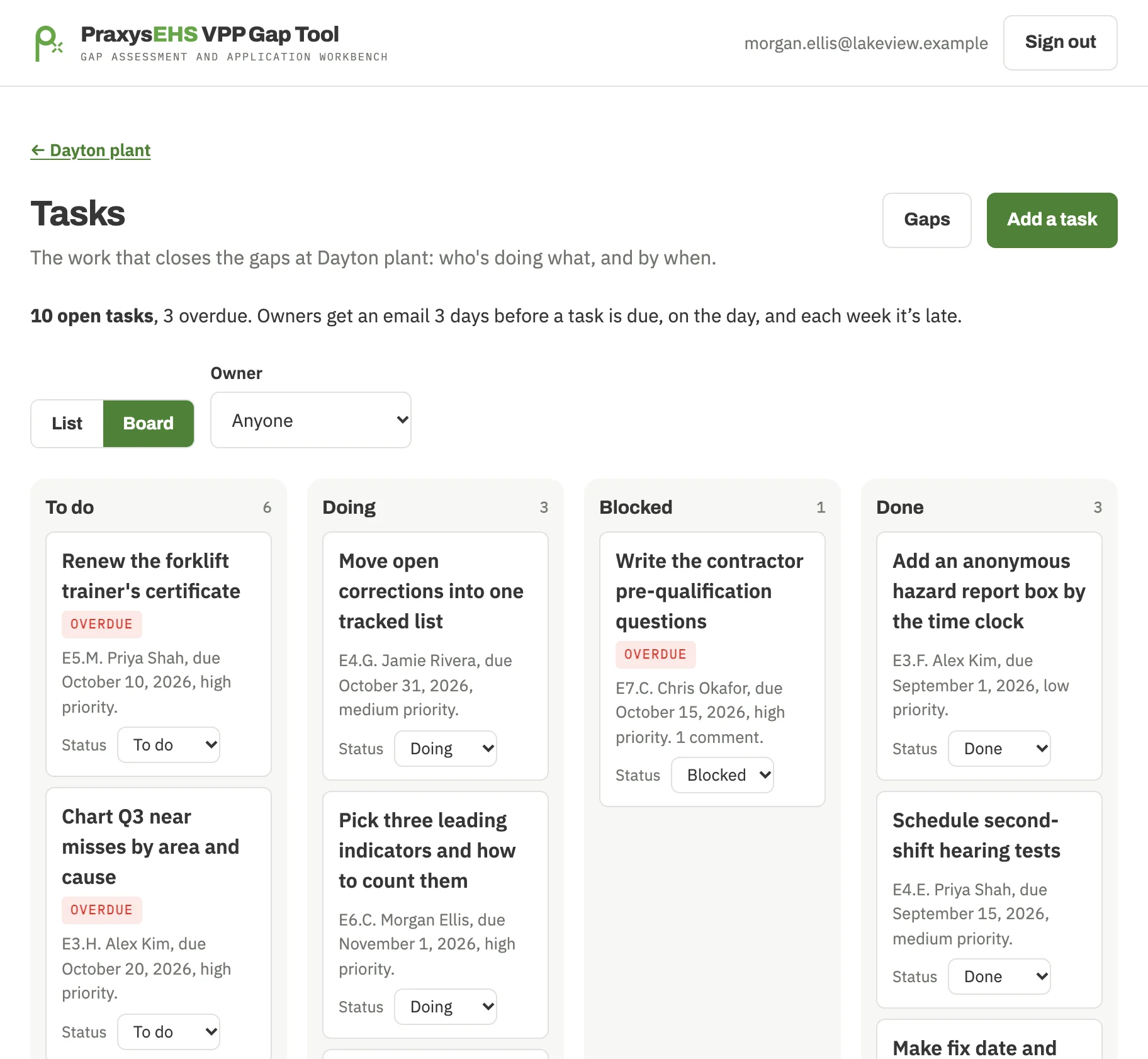
Every gap gets a name and a date
Anything not in place, or only partly, becomes a gap by itself. Turn gaps into tasks, give each one an owner and a due date, and move them across a board. Owners get an email three days before a task is due, on the day, and every week it's late.
- 03
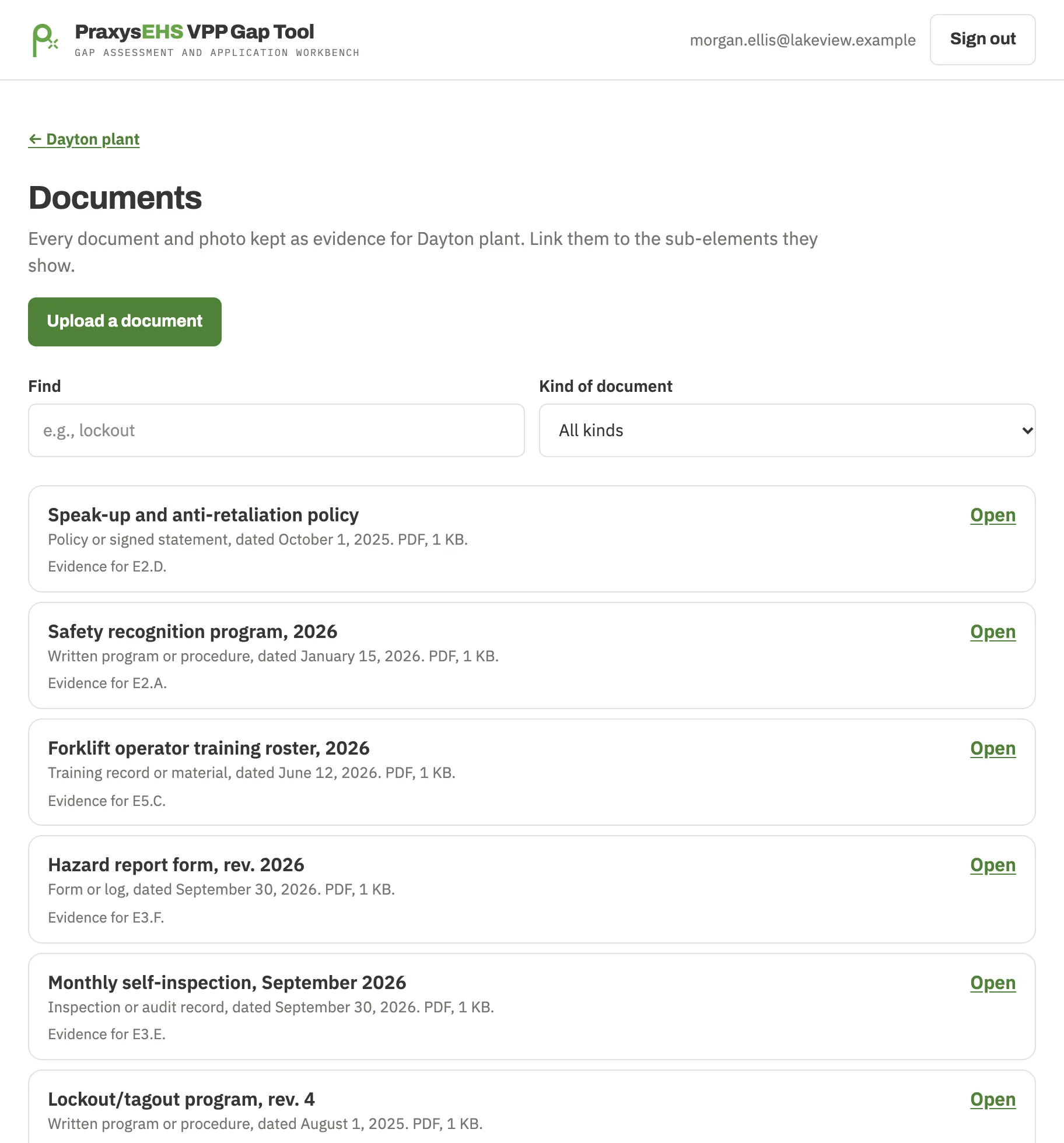
Keep the proof next to the requirement
Upload policies, programs, training records and photos once, and link each one to the requirements it proves. When the application asks for evidence, it's already where it belongs.
- 04
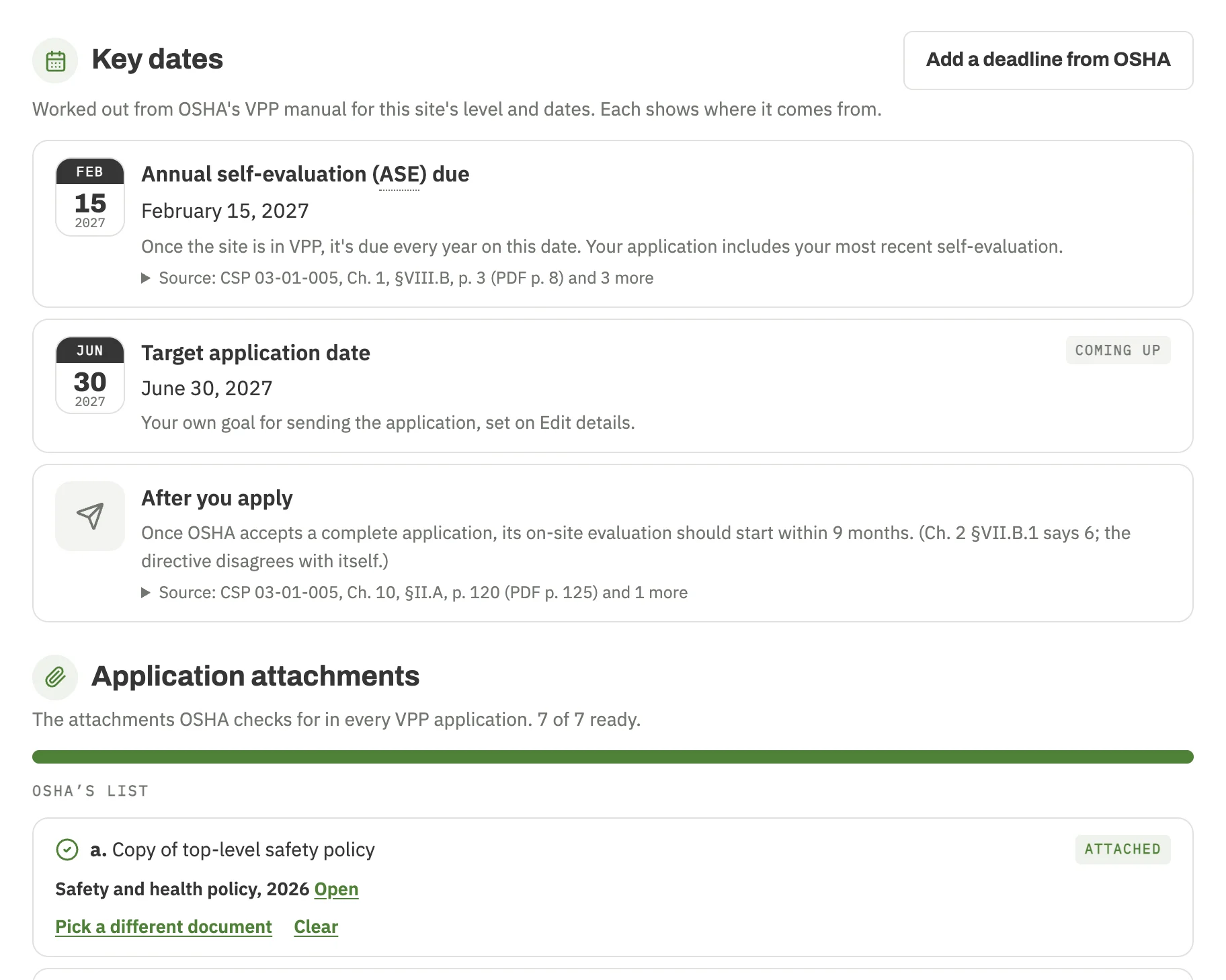
Know what's due, and what OSHA will ask for
Each site has one page that shows where it stands: readiness for each of the seven elements, open gaps, overdue tasks, OSHA's dates worked out for your site, the attachments every application needs, and your injury-rate check against your industry's average.
- 05
Write the application as you go
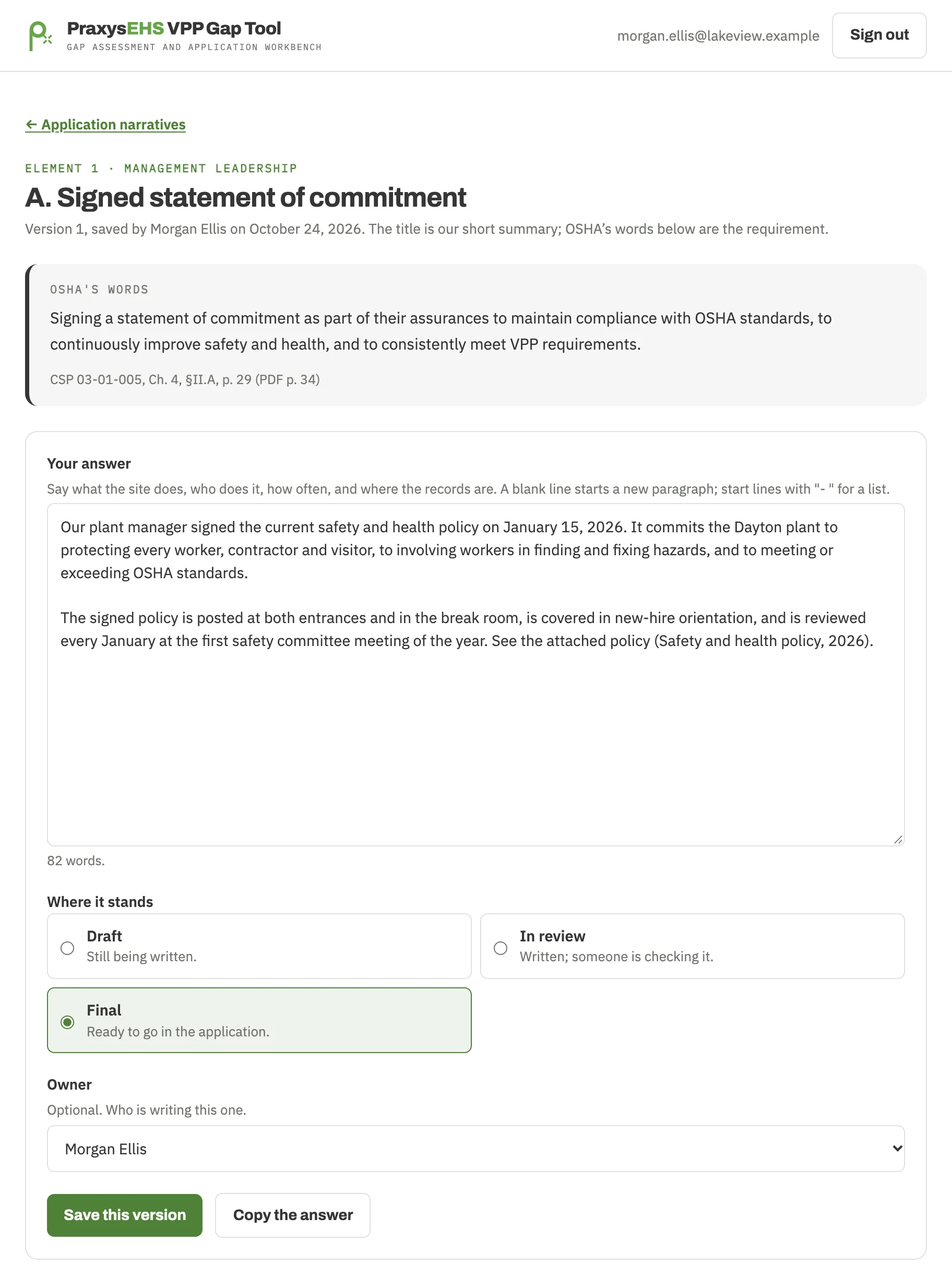
One answer per sub-element, with OSHA's words above the box and your linked documents below it. Every save is a version you can go back to. Mark each answer draft, in review or final, and download one, one element, or the whole site in Word.
- 06
Hand over a report people can read
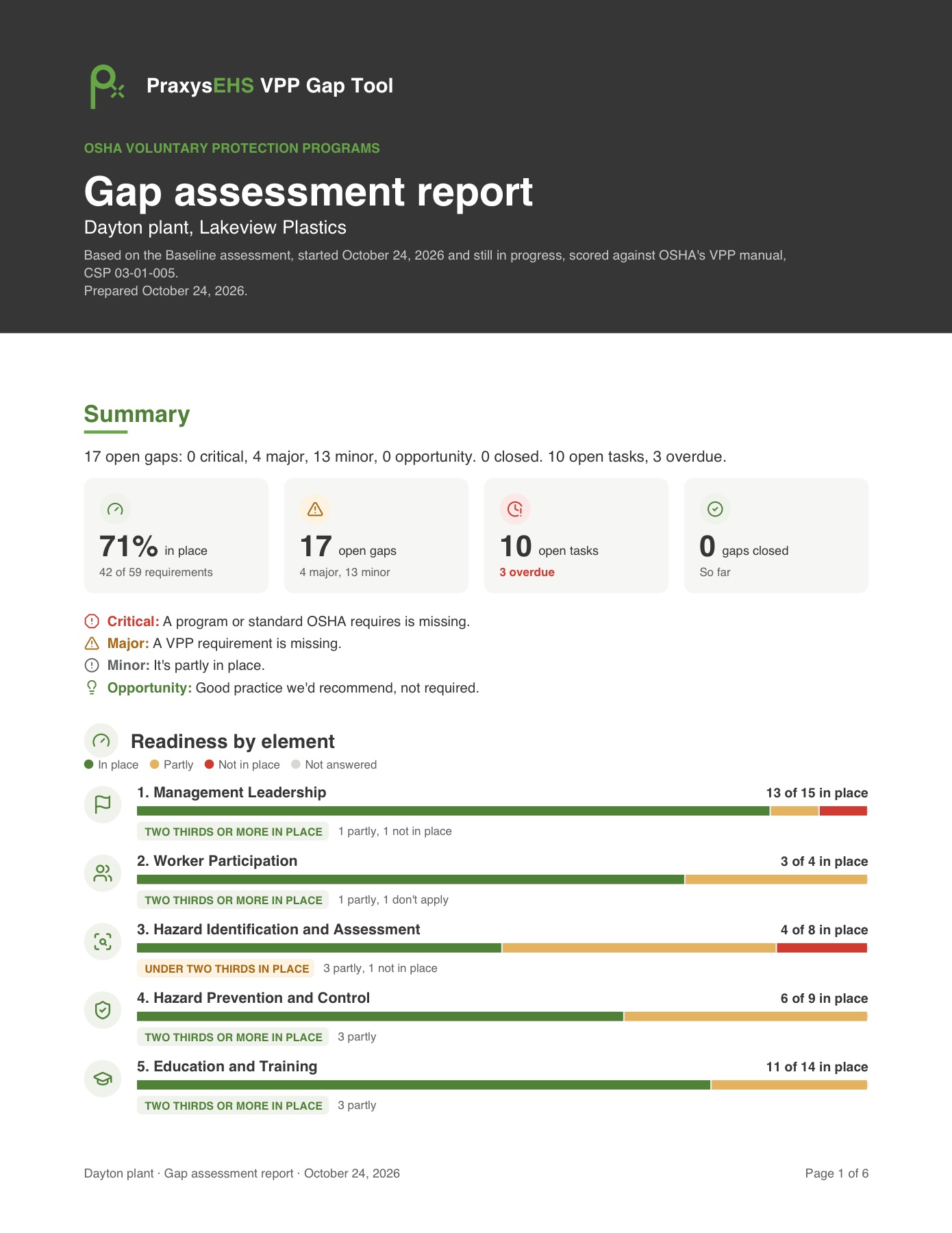
A gap assessment report in PDF or Word: readiness by element, each open gap with how serious it is and what to do about it, and the plan to close them, with owners and dates. Gaps and tasks also come out as spreadsheets.
On the floor
Score it where the work happens.
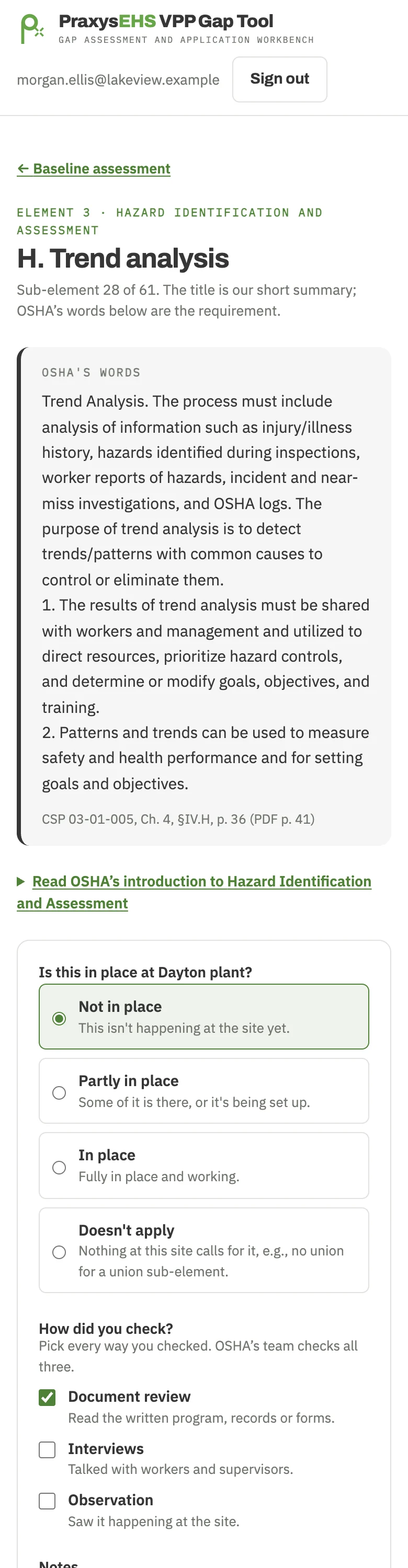
Every screen works on a phone. Walk the floor, talk to the people doing the job, and score the sub-element right there, not from memory back at your desk.
Simple, not simplistic
OSHA says it.We explain it.
Quoted, not paraphrased
Every requirement shows OSHA's own text from the VPP manual, CSP 03-01-005 (in effect since June 16, 2026), with the chapter, section and page.
Dates with their source
The annual self-evaluation, the on-site evaluation window and other deadlines are worked out from the manual, and each one says where it comes from.
When the manual disagrees with itself
It happens. Where two pages say different things, you see both, not our guess.
Our advice, labeled as ours
Where we add guidance, it's marked as ours and kept apart from OSHA's words. It isn't legal advice.
Guidance on every item
Guidance from people who've done it.
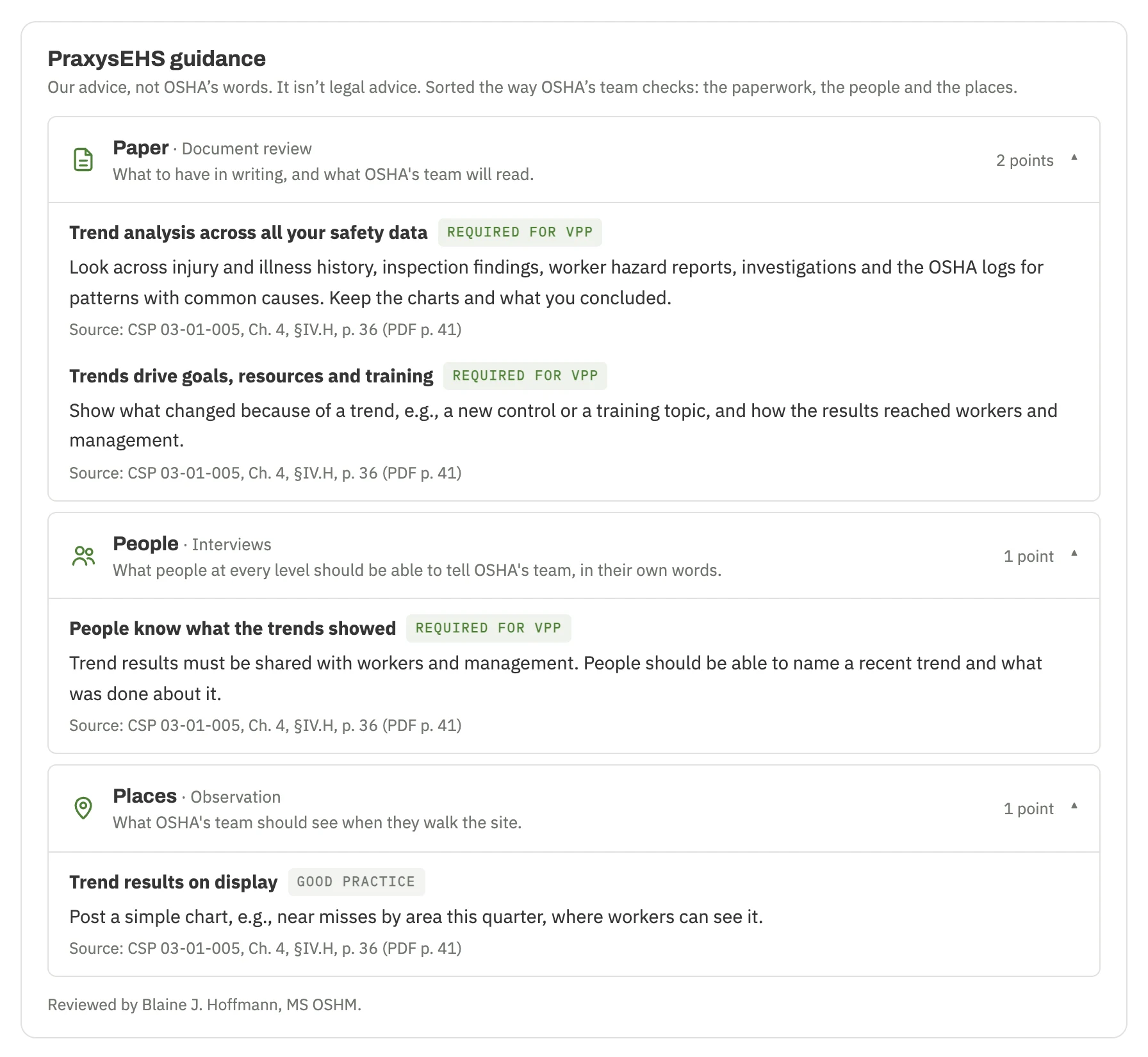
Each of the 61 items comes with step-by-step guidance, reviewed by our partner, Blaine J. Hoffmann, MS OSHM, who has worked on VPP since 2008 and has helped support nearly 30 VPP applications, Star flags and recertifications at federal and private-sector sites. Hoffmann is also the author of Rethinking SAFETY Culture and Rethinking SAFETY Communications, and producer and host of The SafetyPro Podcast. The guidance is sorted the way OSHA's on-site team checks a site:
- Paper · Document reviewWhat to have in writing, and what OSHA's team will read.
- People · InterviewsWhat people at every level should be able to tell OSHA's team, in their own words.
- Places · ObservationWhat OSHA's team should see when they walk your site.
Each point says whether it's required by law, required for VPP, or good practice. It's our advice, labeled as ours and kept apart from OSHA's words. It isn't legal advice.
Experience figures as of October 2026.

Who it's for
This VPP Gap Tool isn't for everyone.
This tool is not for you if:
- you're deeply attached to your 61-row spreadsheet. We understand. Take your time.
- you're hoping software will earn you Star. It won't. Your people will, and this keeps them organized.
- you're a fan of "FINAL_v7." We'll miss you.
Who it is for:
- EHS manager getting a first site ready
- Plant manager who just said yes to Star
- Corporate safety lead with several sites
- Safety consultant who coaches VPP sites
- A Star site keeping its self-evaluation honest
- Safety committee members who want to see where things stand
Who builds it
Decades on the job, not a weekend reading about it.
The people behind PraxysEHS are seasoned safety professionals, each with multiple decades in the field: in plants, on job sites, and in more committee meetings than anyone should have to sit through.
We build alongside our partner, Blaine J. Hoffmann, MS OSHM: three decades in EHS, author of Rethinking SAFETY Culture and Rethinking SAFETY Communications, and producer and host of The SafetyPro Podcast. Every tool is put through its paces by people who've done the job the hard way first.
For consultants
You bill your client. The relationship stays yours.
A free account, free Readiness Checks for prospects, and every client's VPP work in one place with your name on the report. We bill you per client site at list price, never your clients. Once we've confirmed your consulting business, every paid client invoice earns you a 10% credit.
How it works for consultants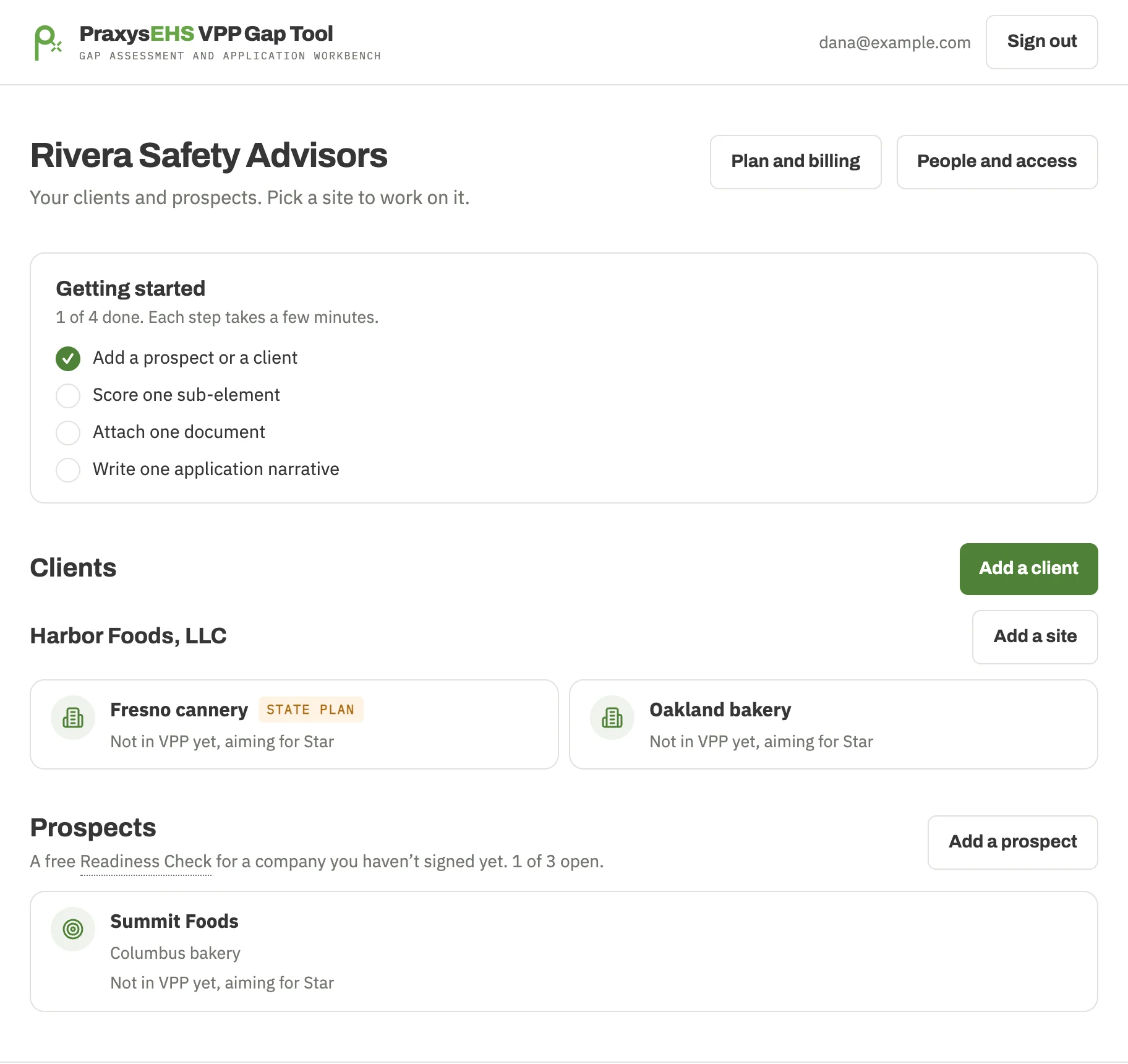
Questions people ask
No. PraxysEHS isn't affiliated with or endorsed by OSHA or VPPPA. The tool quotes OSHA's VPP manual, a public federal document, and says where each quote comes from.
No tool can promise that. OSHA decides, after its own evaluation of your site. The tool helps you find the gaps, close them, and show your work.
The current VPP manual, CSP 03-01-005, in effect since June 16, 2026: seven elements and 61 sub-elements. It's built so a new edition can be loaded when OSHA publishes one.
No. Each requirement has OSHA's words, VPP terms like SHMS, ASE, TCIR and DART are spelled out where they show up, and every screen says what it's for.
Yes, anytime: reports in PDF and Word, answers in Word or Markdown, gaps and tasks as spreadsheets, and your original files. Downloads keep working even if your plan ends.
Yes. Each company's work is kept apart from every other account, files open only through links that expire within minutes, and you decide who's in and what each person can do.
Yes. Mark the site as under a State Plan and the tool reminds you that forms and timing may differ, so you can confirm the details with your state's program.
As many as you need, at no extra cost. Invite your team and give each person a role, from site lead to reviewer.
Start with one sub-element.
14 days free on your first site. No card needed. Free for consultants.
PraxysEHS isn't affiliated with or endorsed by OSHA or the Voluntary Protection Programs Participants' Association (VPPPA). Using the VPP Gap Tool doesn't guarantee VPP approval, and our guidance isn't legal advice. OSHA's words are quoted from its VPP manual, CSP 03-01-005.